 Merrion Design Review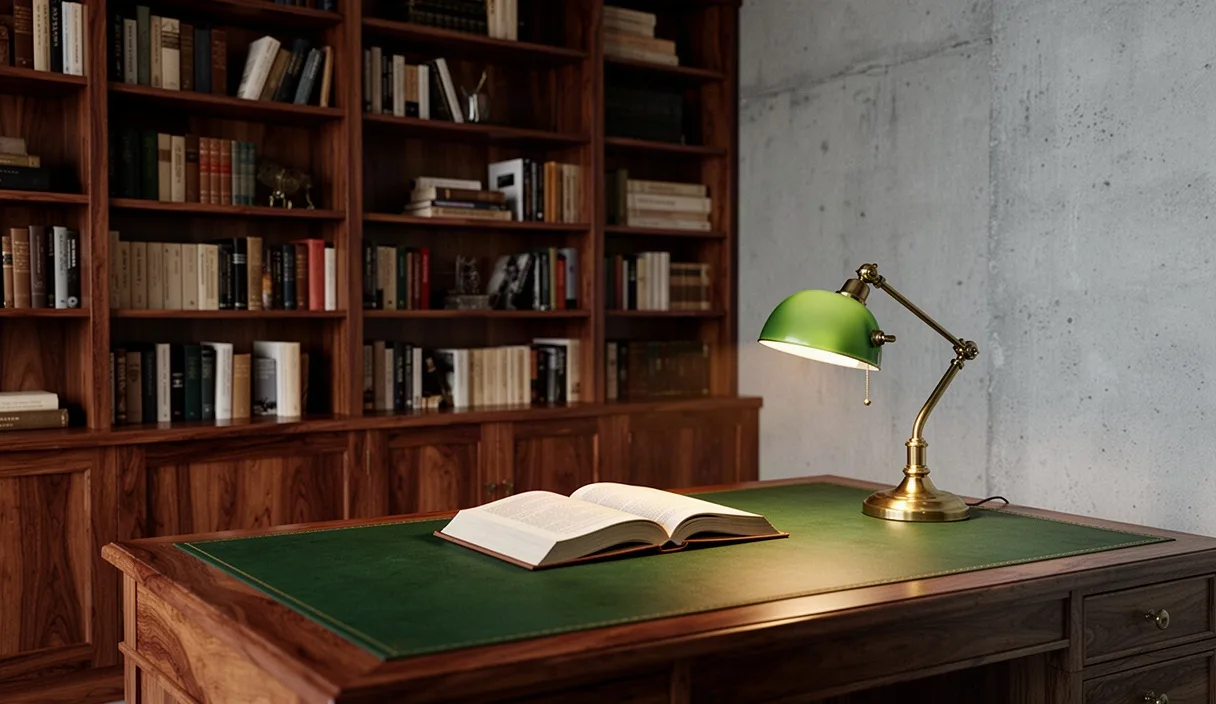

The private study demands an exacting balance between architectural repose and functional clarity. In an interior dedicated to sustained literary or clerical work, illumination serves as an invisible instrument, either quietly sustaining focus or steadily exhausting the reader. When a room is arranged purely for aesthetic sentiment, task lighting is frequently reduced to the warm, dim pools produced by decorative table lamps. Conversely, rooms lit without restraint often suffer from an overabundance of harsh, overhead glare that strips the space of its domestic warmth.
To achieve an environment that respects both the architecture of a residence and the physical demands of long study, one must look to the precise measurement of illuminance. Calculating lux levels provides a reliable, repeatable method for evaluating how light behaves across paper, timber, and surrounding surfaces. By grounding lighting choices in metric calculations rather than intuition alone, one may preserve the dignified character of a reading room while ensuring the eyes remain unburdened through late hours of concentration.
The Mechanics of Visual Fatigue in Private Studies
Visual fatigue, often termed asthenopia by clinicians, develops when the muscular systems of the eye are forced to compensate for inadequate or uneven light distribution. Inside the eye, the ciliary muscle contracts and relaxes continuously to adjust the focal length of the crystalline lens, while the iris adjusts the aperture of the pupil to regulate the volume of incoming light. When the page before a reader is insufficiently lit, the ciliary muscle must sustain a prolonged contraction to resolve fine type, leading to physical strain across the brow and temples.
A second, more pervasive source of fatigue arises from uneven illumination across the field of view. When an individual reads a brightly illuminated manuscript situated within an otherwise darkened room, the peripheral vision detects the surrounding shadow. Each time the gaze shifts from the white margins of the page to an inkpot, a notebook, or a bookshelf across the room, the pupil must dilate, only to constrict abruptly upon returning to the page. Over three or four hours, this recurrent pupillary oscillation depletes retinal adaptation reserves, resulting in dryness, a sensation of grit under the eyelids, and diminished reading comprehension.
One must also distinguish between discomfort glare and disability glare. Discomfort glare produces an instinct to squint without necessarily impairing the immediate visibility of letters, whereas disability glare occurs when light scatters within the optical media of the eye, directly reducing contrast on the printed page. High-gloss papers and varnished desktop surfaces exacerbate this phenomenon by producing specular reflections, effectively masking ink with a veil of white light. Mitigating these mechanical burdens requires the systematic distribution of light rather than simply increasing the wattage of a single central lamp.
Measuring Task Illuminance on the Working Surface
Illuminance is defined as the measure of luminous flux falling upon a specific unit of area, quantified in lux, where one lux equals one lumen per square meter. In an environment dedicated to close reading, drafting, or document review, task illuminance must be measured directly on the working plane, which standard architectural convention places at 75 centimeters above the finished floor. For typical book print, historical broadsheets, and handwriting, a working level of 450 to 550 lux provides sufficient contrast without overwhelming the visual field. When working predominantly on self-illuminated digital displays, a slightly lower range of 300 to 400 lux prevents the desk surface from competing with the monitor.
To measure these values accurately, one should procure an illuminance meter fitted with a cosine-corrected and color-corrected sensor head. The evaluation must follow a disciplined, methodical routine:
- Clear the desk of incidental clutter, leaving only the primary reading pad or open book in its customary working position.
- Place the lux meter flat on the desktop at the center of the reading zone, ensuring the sensor points perpendicular to the ceiling.
- Extinguish all artificial fixtures and draw curtains to measure the baseline daylight contribution, noting the reading.
- Close window shutters or perform the test after nightfall to isolate the contribution of the interior fixtures.
- Energize the ambient room lighting first and record the base lux figure.
- Switch on the dedicated task luminaire, allow modern LED or fluorescent lamps five minutes to reach thermal equilibrium, and record the final operating illuminance.
Calculations for point-source fixtures follow the inverse square law, which states that illuminance is inversely proportional to the square of the distance from the source. The basic formula is expressed as:
E = I / d²
In this equation, E represents illuminance in lux, I denotes the luminous intensity in candelas, and d signifies the distance in meters between the lamp filament and the desktop. For instance, an articulated desk armature delivering 1200 candelas directed downward from a height of 1.5 meters will produce approximately 533 lux directly beneath its beam. Should that fixture be raised to a height of 2 meters, the illuminance falls to 300 lux, illustrating how minor adjustments in luminaire height dramatically reshape the working environment.
Controlling Contrast Ratios Between Desk and Perimeter
Even when a reading surface achieves an optimal 500 lux, the room will feel oppressive if the peripheral surfaces reside in near darkness. Professional illuminating engineering societies recommend adhering to strict contrast ratios across three concentric fields of vision: the task area itself, the immediate surround (such as the remainder of the desk or credenza), and the general perimeter (the walls, ceiling, and floor of the study).
The luminance ratio between the task and the immediate surround should ideally remain within a 3:1 margin, meaning the desk perimeter should receive no less than one-third of the light directed upon the text. Between the task and the distant architectural envelope, the ratio should not exceed 10:1. If the reading material rests under 500 lux, the walls and background joinery should receive at least 50 lux of ambient vertical illuminance. Exceeding these ratios forces the eye into the cycle of constant re-adaptation described earlier.
| Visual Zone | Recommended Lux Range | Maximum Contrast Ratio to Task | Primary Function |
|---|---|---|---|
| Task Surface (Page or Folio) | 450 to 550 lux | 1:1 (Reference) | Ensures fine ink and print definition |
| Immediate Desktop Surround | 150 to 250 lux | 3:1 | Buffers eye movement across writing instruments |
| General Room Perimeter (Walls) | 50 to 120 lux | 10:1 | Maintains spatial orientation and comfort |
| Bookshelf Vertical Planes | 100 to 200 lux | 5:1 | Allows title identification without glare |
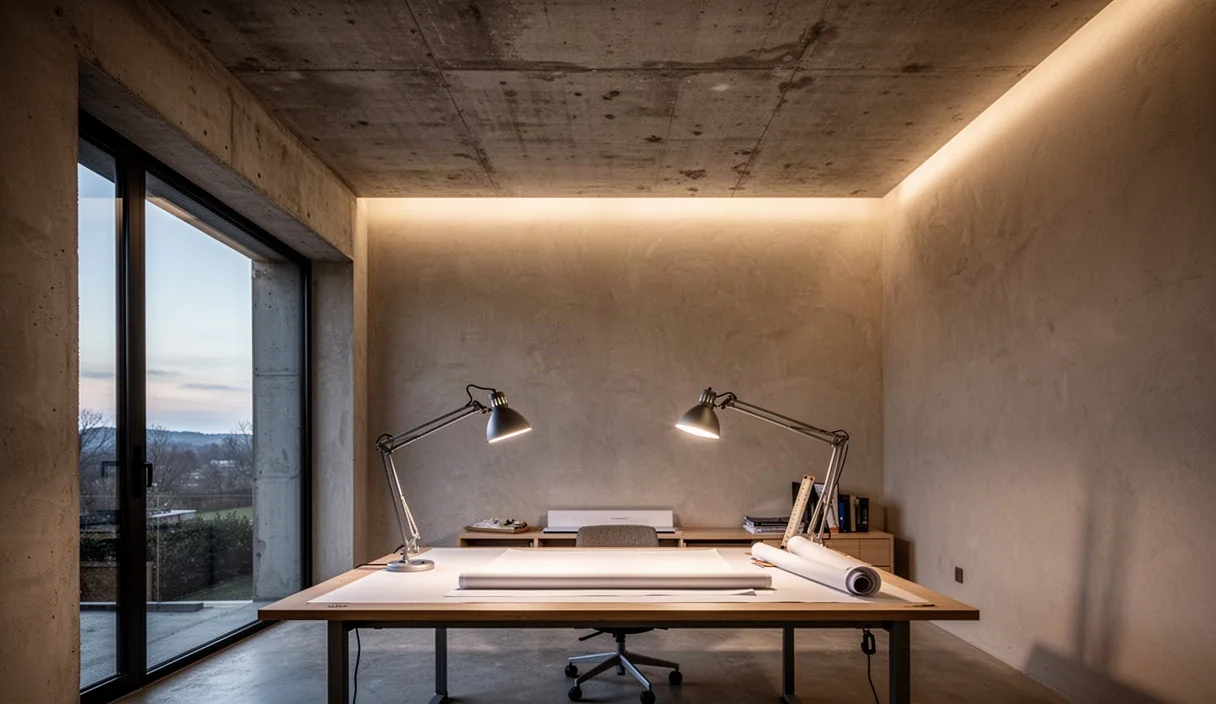
To achieve this visual equilibrium, private studies benefit substantially from layered lighting schemes. Relying on an isolated desk lamp creates a harsh pool of light surrounded by shadow. By introducing low-glare perimeter wash fixtures or shaded sconces directed at plasterwork and millwork, the background plane is gently lifted, preserving the architectural depth of the room while keeping task contrast within acceptable margins.
Selecting Color Temperature for Night Work
Correlated Color Temperature, measured in Kelvin, governs the subjective warmth or coolness of emitted light and exerts a profound effect on nocturnal reading comfort. While commercial offices often deploy cool, blue-enriched light between 4000K and 5000K to stimulate alertness, such spectral profiles feel foreign in a residential library and can suppress melatonin synthesis during evening hours, disrupting the natural circadian transition toward sleep.
For residential studies utilized primarily in the late afternoon and evening, a color temperature between 2700K and 3000K is recommended. A 2700K source closely mimics the warm, reassuring spectrum of historical incandescent tungsten filaments, blending harmoniously with aged leather bindings, mahogany shelving, and wool carpets. If the study serves double duty during business hours for technical drafting or fine editorial correction, a neutral 3000K lamp offers slightly improved optical clarity without appearing clinical.
Beyond Kelvin ratings, one must inspect the Color Rendering Index (CRI), specifically demanding fixtures with a general CRI exceeding 90 and an R9 value (the rendering of deep, saturated reds) above 50. Low-quality solid-state lighting frequently lacks sufficient red spectrum energy, causing wood grains to appear flat, greenish, or lifeless, while rendering cream-colored book papers an uninviting gray. A high CRI preserves the natural tonal warmth of printed materials and the surrounding joinery.
Practical Checklist for Fixture Placement
Correct fixture placement determines whether a calculated lux value translates into visual comfort or persistent annoyance. The following checklist outlines the mechanical and spatial steps necessary to position luminaires effectively within a private reading room.
- Establish the offset angle: Position the primary task luminaire to the side of the reading hand, to the left for a right-handed reader, or to the right for a left-handed reader. This prevents the hand and writing instrument from casting an obstructive shadow across the page.
- Control the incident angle to defeat veiling reflections: Ensure light strikes the desk at an oblique angle between 30 and 45 degrees from the vertical plane. Light aimed straight down from directly above the reader reflects off glossy paper directly into the eye.
- Conceal the luminous source: Select fixtures with deep baffles, louvers, or opaque shades. The physical lamp or LED diode must not be visible within a 45-degree angle of the normal seated line of sight. If the bare light source is visible while reading, discomfort glare will occur regardless of the surface lux level.
- Integrate vertical wall washing: Position narrow-beam ceiling wash fixtures or concealed cove luminaires approximately 60 to 75 centimeters away from bookcases. Directing light vertically down the spines of bound volumes eliminates the cave-like gloom often found along the edges of library shelving.
- Isolate secondary reading armchairs: For an armchair dedicated to leisure reading, provide a dedicated floor standard positioned slightly behind the shoulder of the reader, with the lower edge of the lampshade resting level with the reader's ear, roughly 105 to 115 centimeters above the finished floor.
Common Mistakes in Residential Library Illumination
The most pervasive error in contemporary domestic lighting is the excessive installation of symmetrical arrays of recessed downlights in the ceiling. When downlights are spaced evenly across a plaster ceiling, they illuminate empty floor boards rather than the vertical bookcases or the desk surface, casting deep, unflattering shadows beneath the brows and chins of the occupants. Furthermore, unshielded downlights placed directly above a leather desk blotter create an intense specular reflection that renders reading uncomfortable.
Another frequent oversight involves disregarding the reflectance values of interior finishes. Dark oak paneling, velvet draperies, and deep green wallpaper absorb a substantial proportion of emitted lumens, often reflecting less than 15 percent of the light that strikes them. In such rooms, an illuminance scheme calculated for neutral painted plaster will fail completely, resulting in an underlit perimeter that forces contrast ratios far beyond the 10:1 standard. Conversely, highly polished stone or glass desktops produce severe veiling glare, demanding matte desk pads to diffuse the task light.
Finally, many homeowners rely on unshielded decorative bulbs with exposed reproduction filaments. While visually nostalgic when dimmed to low levels, these bare filaments present an intensely bright focal point that damages visual adaptation when viewed against a darker room. Decorative filament fixtures should be reserved for low-wattage ambient accentuation and kept outside the direct sightlines of the seated scholar.
Practical Next Steps for the Homeowner
To refine the lighting in an existing study, begin with an unhurried evening inspection. Seat yourself at the desk with your customary reading material and observe where the eye feels drawn or irritated. Use an inexpensive hand-held lux meter to measure the illuminance across the page, the blotter, and the immediate perimeter of the desk, noting whether the working field falls within the suggested 450 to 550 lux boundary.
Next, assess the perimeter contrast. If the bookcases and surrounding walls appear dark and cavernous while the desk is lit, introduce low-output, high-CRI accent lamps or floor-directed washers to lift the background plane. When structural changes are contemplated, such as modifying recessed ceiling circuitry, commissioning custom joinery with integrated linear LED profiles, or rewiring historic luminaires, it is prudent to consult an architectural lighting designer or a certified electrical engineer. These specialists can compute point-by-point ray-tracing models and verify electrical safety, ensuring your private library achieves the quiet visual permanence appropriate to a home of distinction.